
The Science of Ice Cream
The inside scoop
Ice cream is a frozen dairy dessert, but you cannot legally make ice cream by freezing milk. In the US and much of Europe, ice cream must contain at least 10% fat—more than milk naturally holds. If you concentrate milk by boiling off water to raise its fat content, you may pass the legal hurdle, but frozen concentrated milk will never pass as ice cream.
So the problem is: how to make good ice cream? Step one of our foolproof plan of solving hard problems is to define it: what do we mean by “good”? There are two aspects when it comes to ice cream: flavor and texture. Surveys show tastes are surprisingly universal: vanilla, chocolate, and strawberry top the list worldwide. Still, “de gustibus non est disputandum”—in matters of taste, there can be no dispute. So I will stay out of that side of the equation. Instead, I will focus on how to achieve the best texture, which is the defining feature, and the most technically challenging part in the making of good ice cream.
Here is my definition of good plain ice cream: it should be firm yet pliable. It should taste smooth with no detectable particles. It should not feel greasy or gummy. The biggest mystery about ice cream is: how to keep it with just the right rheological properties coming out of the freezer? The answer is in the ingredients and manufacturing process.
Ingredients of Ice Cream
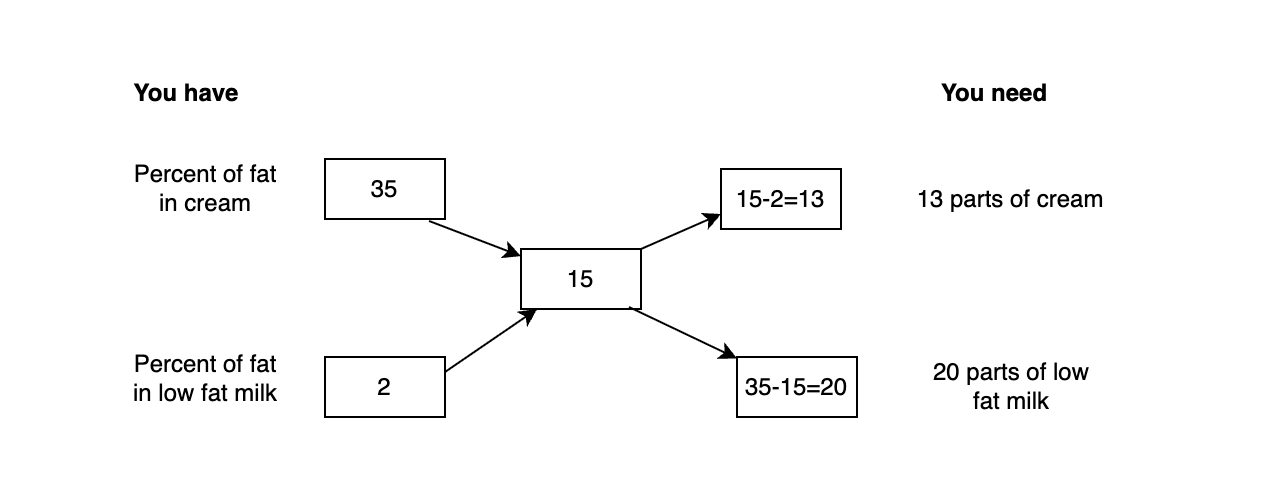
In principle, ice cream needs only cream, milk, and sugar. Quick: If you have cream (35% fat) and low-fat milk (2% fat), and you need to make an ice cream mix of 15% fat, what is the ratio of cream and low-fat milk? You could solve two linear equations with two variables, or you could solve it with the Pearson Square:
First you write down the percentage of fat in each of your ingredients on the left-hand side and the target in the middle:
Figure 1
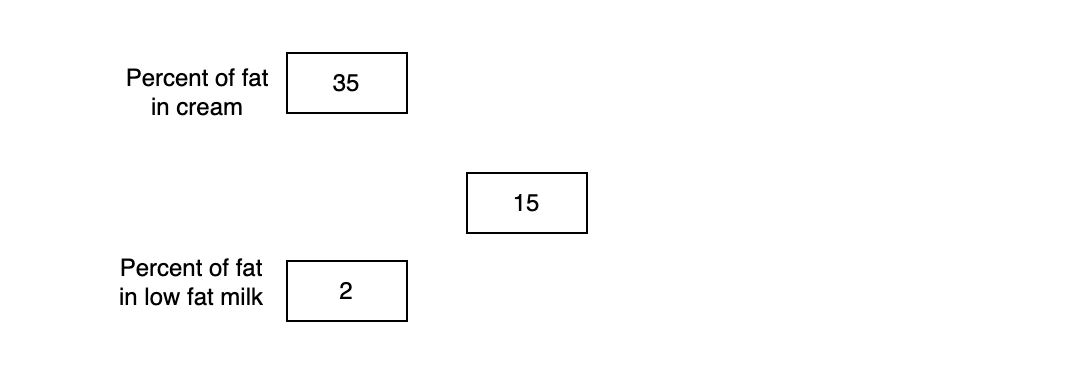
Next, calculate the difference between the number on the left and the center, and arrive at the number on the diagonal corner. For instance, on the bottom left corner you have 2 (the fat content of low fat milk). The difference between that and the number in the middle, 15 (your target fat content), is 13. Write that down on the top right corner, this is the ratio of cream, as shown in the figure below.
Figure 2
Commercial ice cream demands control of more than just fat percentage. Its building blocks include milk fat, sugar, milk solids-not-fat (MSNF), water, and a small dose of ‘magic dust.’ The composition has to be carefully controlled to achieve the desired texture. Many ingredients bring with them more than one basic component, and they change the ratio of multiple components simultaneously. Mix calculations get complicated fast. Here are some sample ice cream mixes:
Table 1: The Content of Ice Cream Mix
| Composition (%) | Economy ice cream (10.0) | Premium ice cream (18.0) |
|---|---|---|
| Milk fat | 10.0 | 18.0 |
| Milk solids-not-fat | 11.0 | 9.5 |
| Sucrose | 10.0 | 14.0 |
| Corn syrup solids | 5.0 | – |
| Stabilizer | 0.35 | - |
| Emulsifier | 0.15 | 0.15 |
| Total solids | 36.5 | 41.65 |
| Air (overrun) | 100 | 25 |
A few things to note in this table:
- Right away you can see this isn’t about ingredients you pick up at the store—milk, cream, sugar. We’re looking at the functional constituents.
- The fat doesn’t have to be milk fat, but it’s devilishly difficult to replace it. I will have more to say when we discuss low fat ice cream later. Premium ice cream contains more fat.
- Sucrose is another name for cane sugar. Corn syrup solids serve the similar function. Other sweeteners may also be used, but premium ice cream usually uses only sucrose.
- The percentage for solids are of weight, but the percentage for air is of volume. 100% overrun means the air takes as much volume as the rest of the ice cream. Premium ice cream has lower overrun.
- Stabilizer and emulsifier: These are the magic dusts. They play important roles in creating the right texture. They are often natural—for example, eggs provide lecithin, a natural emulsifier.
- Counterintuitively, the emulsifiers are not here to stabilize the emulsion, but to destabilize it. We will talk more about it when we discuss the microstructure of ice cream.
- The homemade ice cream recipes you find online don’t call for stabilizers or emulsifiers. They don’t need to—your batch isn’t meant to survive months in a supermarket freezer. The texture won’t be flawless, but that’s a small price for the novelty of making your own.
Once the mix is formulated, the next question is how to transform it into ice cream. The answer lies in a sequence of carefully controlled steps.
Manufacturing Ice Cream
This is a typical manufacturing flow of commercial ice cream:
Figure 3
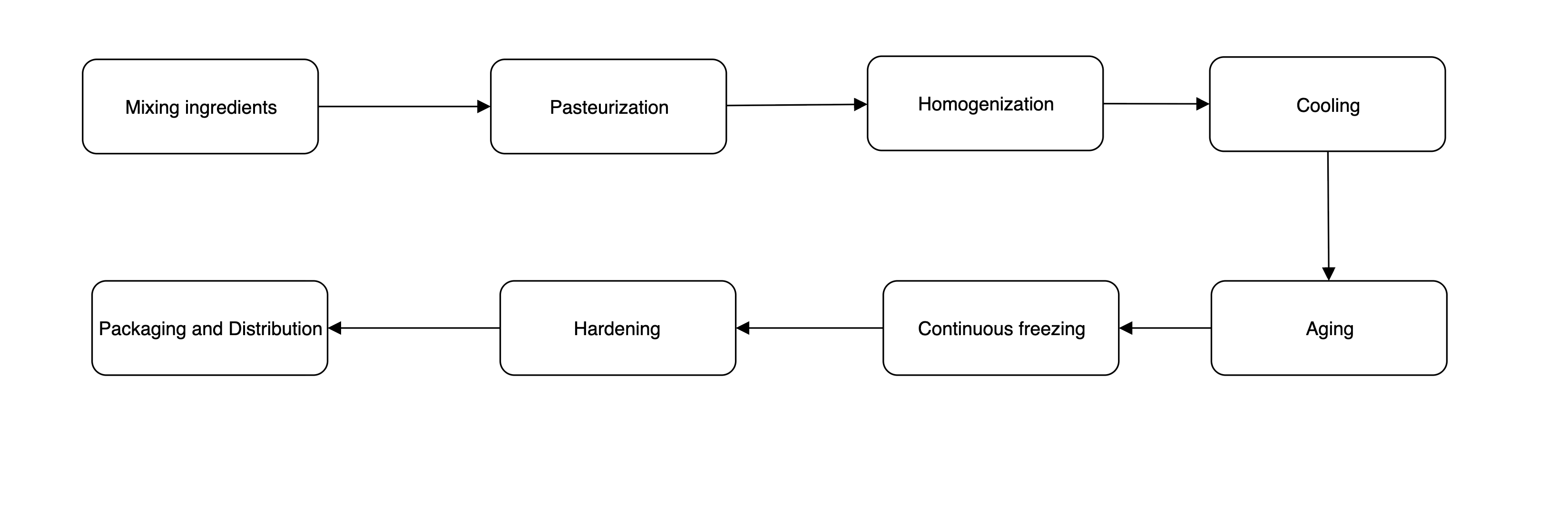
Pasteurization
The first step is pasteurization: heating the mix under controlled conditions. It achieves several things at once:
- It kills all the germs. As we talked about with the thermal death curve, it’s a combination of time and temperature.
- It melts all the fat to prepare them for homogenization. Milk fat contains multiple types of triglycerides with different melting points. Not all of them melt at room temperature. Nor do they all crystallize near 0°C
- The elevated temperature serves three purposes: it makes homogenization more efficient, it activates the stabilizers, and it helps dissolve the solids, especially the sugars.
Homogenization
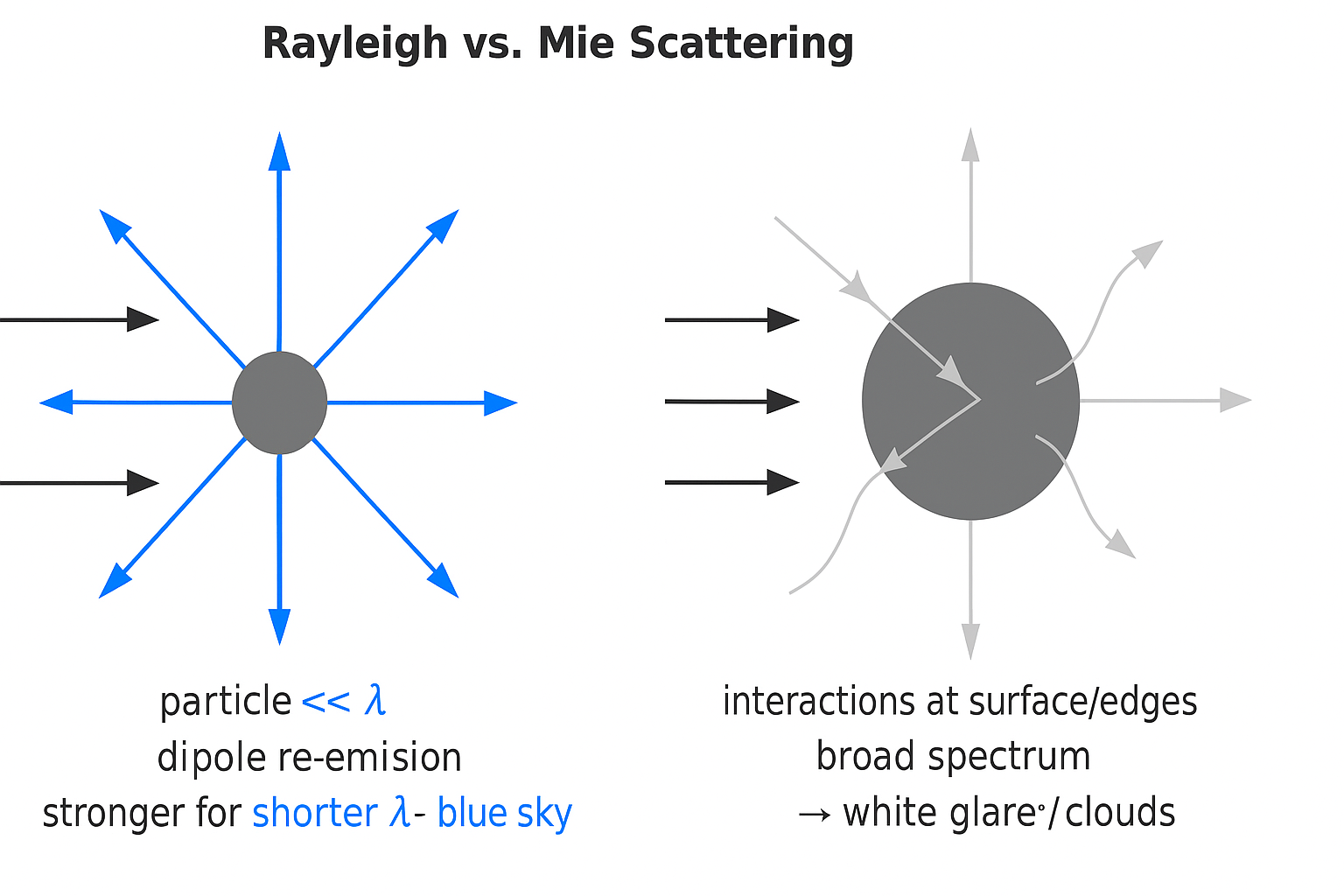
Pasteurization prepares the mix for homogenization, the next critical step. To understand why, we first need to know something about milk’s structure—starting with why milk looks white. The reason is Mie scattering. The fat globules in milk are about the size of visible light’s wavelength, so light waves bounce, bend, and diffract in ways that scatter all colors more or less equally. The result is a broadband effect—we see white. Rayleigh scattering, by contrast, happens when particles are much smaller than the wavelength. In that case, the light shakes the particle like a dipole, which then re-radiates light more strongly at shorter wavelengths. Because blue light scatters far more than red, the sky—our largest optical experiment—looks blue.
Figure 4
But the fat globules in milk are not stable enough for the manufacturing of ice cream. They are so big and light that they will eventually float to the top and separate from the rest of the milk. To keep them distributed evenly in milk, they must be homogenized. The main purpose of homogenization is to make a stable and uniform suspension of the fat by reducing the size of fat globules to about 2 µm. According to Stokes’ law, the rate of rising is proportional to the square of the radius. The 10x reduction in size means the globules rise 100 times slower. Also, the globules are stabilized by the milk proteins that adsorb to the surface. These proteins provide electrostatic repulsion that keeps the globules away from each other.
Homogenization can happen either before or after pasteurization, but it’s more efficient to do it after for these reasons:
- Fully liquid fat is easier to homogenize. The mix has to be heated to melt all fat.
- Higher temperature reduces the viscosity of both the fat phase and the water phase –> less resistance to flow and breaking up droplets.
- Milk proteins adsorb more easily to globule surfaces at elevated temperatures.
But now the fat globules are too stable. Later on we need them to undergo controlled breakage so they can stick together to provide structure. This is where the emulsifiers come in. Compared to milk proteins, they are smaller and more effective in reducing the interfacial tension at the fat-water interface. They replace milk proteins on the globule surface, weakening the boundary. As the fat inside crystallizes and pierces the surface, globules stick together and form a network. It’s important we have partial coalescence. If there is no coalescence, the fat globules are well protected and float away from each other, and the ice cream becomes overly mushy. If the fat globules coalesce completely, we have butter.
Cooling and Aging
After homogenization the ice cream mix is cooled to about 2°C. The mixture has to be cooled rapidly so it doesn’t linger in the warm zone that promotes bacteria growth. The cooling also starts the crystallization of fats. Milk fat contains multiple triglycerides with different melting points. As temperature drops, the triglycerides with higher melting points solidify first and these become the seeds of crystals. At 4°C, almost all of them crystallize.
2°C is as close as we can come to freezing without actually crossing the line. The mix isn’t ready yet; it needs to age. In commercial plants, that means four hours of quiet rest while two things happen. Emulsifiers slowly nudge proteins off fat globules and take their place. Stabilizers, those long polysaccharide chains, slowly drink in water and unfurl from their crumpled state. Only then is the mix ready for freezing.
Dynamic Freezing
On a camping trip, I once watched Boy Scouts make ice cream by putting the mix in a small container nested inside a larger one filled with ice and salt. The outer container was painted like a soccer ball. Once sealed, they kicked it around for half an hour, and when they opened it, the mix had turned into ice cream. The lesson: good ice cream requires constant motion while it freezes.
Commercial ice cream is made in the continuous freezer. It’s a freezing cylinder surrounded by refrigerant. Inside the cylinder is a dasher with sharp blades that scrape the inner surface of the chamber. As the mixture enters the cylinder, those near the surface are frozen first and form a thin ice sheet. The dasher rotates at a speed of 100-200 rpm. It scrapes the ice off the inner wall, mixes the contents to promote rapid cooling, and breaks up large ice crystals. In the meantime, air is whipped into the mixture. In commercial ice cream production, this air is metered to control the overrun.
The shear force of the dasher breaks the protective membrane around fat globules, and partial coalescence begins. Globules bump together, form clusters, and link into a loose fat network. In a continuous freezer the mix only spends about a minute under this treatment, but in a soft-serve machine it can be whipped for hours. Push the process too far and you get a common defect: a buttery texture from excessive coalescence.
This mechanical churning is also why most homemade recipes manage without added emulsifiers. A fat network still forms—just weaker and less durable. For ice cream eaten fresh, that’s perfectly fine. It only becomes a liability if the batch sits for weeks, subjected to freezer doors opening and closing, when the fragile structure eventually gives way to iciness.
You may wonder: in dynamic freezing, with the dasher constantly churning, shouldn’t all that energy just warm up the mix? It doesn’t, because the freezer pulls the heat away as fast as it’s added. What the mixing really changes is how the ice forms. Instead of a few crystals quietly growing bigger, the dasher keeps breaking them apart, so the mix freezes into countless tiny ones.
The catch is that small crystals come with a hidden cost. More crystals mean more total surface area, and surface area carries what’s called surface free energy—the extra energy stored at the boundary between ice and liquid. The greater the area, the more energy is required to create and maintain it. That’s why small crystals are harder to form and less stable than large ones. By constantly breaking crystals apart, the dasher pays this energy cost repeatedly, forcing the system into a state of many tiny crystals. The result: smooth, creamy ice cream instead of an icy crunch. It will become clear in the course of our discussion that a lot of mental energy is spent in the ice cream industry to keep the ice crystals small.
The exit temperature is about -6°C. The dissolved sugars and salts lower the freezing point, so only about 50% of the water is frozen and the mix doesn’t lock up into a solid block at this temperature. Instead, you get a semi-frozen state that’s soft enough to be pumped and molded.
At this point the ice cream could be sold as soft-serve. In reality, soft-serve ice cream has slightly different recipes. They typically have more sugar so the freezing point is more depressed. The resulting higher water-to-ice ratio gives it a more flowing and smooth mouthfeel. It’s a big concern for soft-serve ice cream to retain its shape, so more stabilizer is added to increase the viscosity, and more emulsifier is added to further destabilize the fat to help form connections in the fat network. But because of the risk of churning (making butter), fat content is generally lower.
Hardening
As the product comes out of the continuous freezer, if we leave it at -6°C, ice crystals will go through Ostwald ripening: small ice crystals disappear and big ones get bigger. Just as water runs from high ground to low, water molecules migrate from places with higher chemical potential to places with lower chemical potential. For a solid-liquid interface, the chemical potential of a curved particle is given by:
: the excess chemical potential. : radius/curvature. : molecular volume.
Water molecules spontaneously leave (melt from) small ice crystals and redeposit onto larger ones. Not because they have free will, but because small ice crystals have a lower melting point according to the Gibbs-Thomson equation:
- : melting point of a crystal with radius .
- : the bulk melting point — what you’d measure for a very large, flat crystal.
- solid–liquid interfacial tension (energy cost of having a boundary between solid and liquid).
- : density of the solid.
- :latent heat of fusion per unit mass (energy needed to melt 1 g or 1 kg of the material).
- : radius of the crystal (or curvature scale). Smaller means sharper curvature.
A thermodynamic system always tries to reduce its free energy by sacrificing small, highly curved objects to feed larger, flatter ones (Not because the larger ones have bigger stomach, but it’s more fun to write than “the gradient of the free energy drives flux”). That’s the same fundamental reason air bubbles in ice cream get bigger, even though the mechanism is different. The internal pressure of air bubbles is given by the Laplace equation:
- : pressure difference (inside – outside the bubble)
- : surface tension
- : bubble radius
Smaller bubbles (smaller ) have higher internal pressure. The pressure pushes gas molecules out of the small bubbles through the liquid into larger bubbles. From an energy standpoint, the air/liquid surfaces require energy to maintain. The bigger the surface area, the more energy it costs. The total surface area of many small bubbles is much larger than the surface areas of a few big bubbles containing the same volume of gas.
Now we can explain why homogenization after pasteurization is more efficient: breaking fat globules down to a tenth their diameter increases the number of globules roughly a thousandfold and the total surface area roughly tenfold. Creating that much new interface takes energy, and the warmer, lower-viscosity mix makes the work easier. The same surface-area argument is why I prefer filter coffee over espresso.
During hardening, the temperature is dropped to at least -18°C, preferably to -25 to -30°C. Hardening rooms in ice cream factories are normally kept at -40°C. More water becomes ice in the cooling process, following the freezing point depression curve. Rapid cooling is preferred because it drives the mix below the melting point of even small, highly curved crystals before they can disappear, and because lower temperatures slow the molecular migration that feeds large crystals. The goal is to lock in many small crystals instead of giving water time to migrate to the large ones. Even so, ice crystal size typically grows by 30-40% (from about 25µm to 35µm).
Cooling speed is determined by the speed of heat transfer:
- : heat transfer rate
- : overall heat transfer coefficient
- : exposed surface area.
- : the temperature differential between the hardening room air and the ice cream core.
Some things to note about this equation:
- U is affected both by conductive and convective transfer. Fat and air have lower conductive transfer coefficients than ice. So more fat and more overrun cause a slower temperature drop.
- To increase convective heat transfer speed, high-velocity cold air is blown across the ice cream packages.
- To increase , the surface area, ice cream is put into retail-size cartons before hardening. It’s the same reason frozen broccoli is cut into small pieces: not to charge you for the extra labor, but to speed up the freezing so it keeps fresh.
Cryogenic Freezing
There is one way to push both and to the extreme: liquid nitrogen (temperature: below –196 °C). With it, you don’t even need the dynamic freezing stage—you can start with plain mix. Pour liquid nitrogen over it, and the temperature plunges so quickly that the mix solidifies almost instantly. Water molecules are locked in place before they can gather into crystals. Technically they still move, but so slowly that, on human timescales, it’s as if they’ve stopped. The result is a glassy state: a solid without the ordered lattice of ice.
In ordinary low temperatures, the most stable form of water is crystalline ice—molecules neatly arranged, the system at its minimum Gibbs free energy, no tendency to rearrange further. In the glassy state, by contrast, the system is trapped above that minimum. The water molecules are like inmates of a prison: they are restless with excessive energy, but they can’t move.
Because the mix falls into the glassy state so quickly, cryogenically frozen ice cream forms very few crystals and traps almost no air. The texture is smoother, denser, almost otherworldly. The Fat Duck famously serves the “nitro-scrambled egg and bacon ice cream”.
The glass transition temperature is the point below which ice cream mix locks into a glassy state. Drop the mix into liquid nitrogen, and it freezes past that point almost instantly — that’s the trick behind Dippin’ Dots. The glassy state is unstable: once the temperature creeps above the glass transition, water molecules regain mobility and start crystallizing. Crystallization releases latent heat, which pushes the temperature up even more — a runaway loop that can melt the surface of Dippin’ Dots and make them clump. That’s why you don’t see them everywhere: they need freezers colder than the usual kind. But no, they are not cold enough for the first batch of Covid vaccines.
The Microstructure of Ice Cream
Is ice cream solid? A solution? A gel? A foam? The answer is all of the above. Technically, ice cream is a colloid of colloids. A colloid is one of those things that are very frustrating to read about because no one ever seems to explain it. Let’s fix that.
A colloid is a mixture, where tiny particles of one substance are stably and evenly distributed in another substance. Sugar dissolved in water is a type of mixture, and a bag of trail mix is another. Where does one type of mixture end and another begin?
Table 2: The Difference between Solutions, Colloids and Heterogeneous Mixtures
| Property | Solution | Colloid | Heterogeneous Mixture |
|---|---|---|---|
| Particle size | < 1 nm (molecules, ions) | 1 nm – a few µm (droplets, clusters, bubbles) | > a few µm (grains, chunks, visible) |
| Appearance | Transparent, no scattering | Cloudy/opaque, shows Mie/Tyndall effect | Clearly non-uniform, separate parts visible |
| Stability | Stable, doesn’t separate | Stable but may separate slowly (e.g. cream rises in milk) | Unstable, separates quickly (settles or layers) |
| Filterability | Passes through all filters | Passes through paper, blocked by ultrafilters | Can be separated by sieving or simple filtration |
| Light interaction | No scattering | Scatters light (Tyndall effect) | Just blocks/reflects light randomly |
| Examples | Salt water, sugar water, vinegar | Milk, mayonnaise, whipped cream, gelatin | trail mix, salad |
In a colloid, the dispersed substance makes up the dispersed phase, while the other substance makes up the continuous phase. Both the dispersed phase and the continuous phase can be gas, liquid or solid. Depending on which is which, different types of colloids are called different names.
Table 3: Different Types of Colloids
| Colloid Class | Dispersed Phase | Continuous Phase | Food Examples |
|---|---|---|---|
| Emulsion | Liquid | Liquid | Milk, mayonnaise, vinaigrette, butter |
| Foam | Gas | Liquid or solid | Whipped cream, meringue, bread, ice cream |
| Gel | Liquid | Solid | Gelatin dessert, custard, cheese, tofu |
| Sol | Solid | Liquid | Gravy, soup stock, chocolate milk |
| Solid Foam | Gas | Solid | Bread, cake, marshmallow |
| Solid Emulsion | Liquid | Solid | Butter, margarine, ice cream (partially) |
So now you know the difference between vinegar and vinaigrette: one is a solution, the other is an ongoing struggle with autocorrect.
We find several kinds of colloid in ice cream:
Table 4: Colloids in Ice Cream
| Colloid type | Dispersed phase | Continuous phase | Function in ice cream |
|---|---|---|---|
| Foam | Air bubbles (gas) | Liquid mix / semi-solid | Makes ice cream light, soft, and scoopable |
| Emulsion | Fat globules (oil) | Serum | Provides creaminess, body, and flavor release, slows ice crystal growth |
| Suspension (sol) | Ice crystals (solid) | Serum | Gives frozen structure |
| Suspension (sol) | Milk proteins (solid) | Serum | Stabilize fat, trap air, add smoothness, slows ice crystal growth |
| Gel-like network | Stabilizers (polysaccharides, proteins) | Serum | Control water mobility, slow ice crystal growth, improve melt resistance |
The serum—the continuous phase of several of the colloids—is what holds the entire structure together. Once something is dissolved in water, it gets in the way of the water molecules. They find it harder either to escape into vapor or to settle into an orderly solid lattice. The result is that the solution stays liquid longer: its boiling point rises, and its freezing point falls. Thermodynamics formalizes this with Raoult’s law:
- : The vapor pressure of the solvent in solution.
- : The mole fraction (always less than one),
- : The vapor pressure of the pure solvent.
Dissolving solutes lowers , and thus lowers (P_A). Lower vapor pressure means the liquid resists evaporation. The practical freezing-point version of the same thermodynamic idea is:
- : the freezing-point drop.
- : the number of dissolved particles produced per molecule of solute.
- : the solvent’s freezing-point-depression constant.
- : molality, the amount of solute per kilogram of solvent.
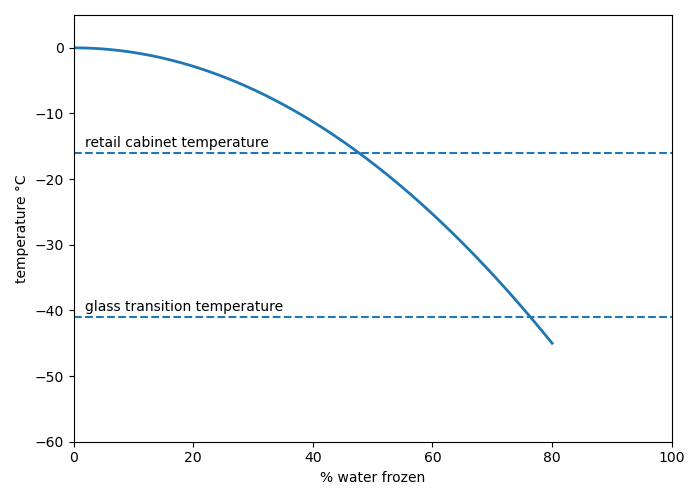
Ice cream mix is not an ideal dilute solution, but the useful lesson survives: the freezing point is pushed lower mainly by the number of dissolved particles, not their size. A gram of table sugar contributes thousands of times more molecules than a gram of protein, so it has a far stronger effect on freezing. That’s why small-molecule solutes dominate the freezing point depression curve shown below.
Figure 4: The Freezing Point Depression Curve
By the way, the salts come from milk’s natural minerals — mostly calcium, potassium, and phosphate compounds. They’re not sodium chloride, so they don’t taste salty but still affect texture, freezing point, and protein stability.
You know those freezer cabinets where several tubs of ice cream sit side by side? Some flavors always seem to sell out first. Are they really more popular — or just softer? The extra molecules from flavorings can shift the freezing curve, so at a given temperature one flavor may scoop easier simply because less water has frozen. Wouldn’t it be nice if popularity were always decided by science?
Another key element of ice cream’s structural integrity is the fat network, built from partially coalesced fat globules. This network physically blocks water molecules, slowing their movement toward ice crystals. The fat network also supports the air bubbles so they don’t collapse easily. Stabilizers add another layer of resistance by thickening the serum, further reducing water mobility and slowing crystal growth. The thickened serum also stabilizes air bubbles by slowing leakage through their liquid walls.
Recipes for homemade ice cream don’t need industrial emulsifiers. Most homemade recipes skip emulsifiers altogether, and that’s not a mistake. The reason is simple: homemade ice cream is eaten fresh. Commercial ice cream needs emulsifiers to hold up through weeks of transport, supermarket storage, and your freezer door being opened and closed a hundred times. At home, the timeline is shorter and the requirements gentler. Milk proteins already do a passable job of keeping fat droplets from fusing, and if egg yolks are in the mix, you’ve added a natural emulsifier without even trying. The result may not be as bombproof as a pint from the store, but it doesn’t need to be—you weren’t planning to keep it around for a month anyway.
Premium ice cream typically contains more fat and uses only sucrose for sweetness. It doesn’t have added stabilizers, instead relying on sugar, proteins, emulsified fat globules and other dissolved particles in the MSNF (Milk-Solids-Not-Fat) to increase viscosity of the serum phase. This makes it more vulnerable to periods of temperature fluctuation, also known as heat shocks. The heat shocks don’t have to be very hot. Cycling the temperature between -10°C and -20°C is enough to noticeably increase the average size of ice crystals over time. Therefore premium ice creams demand stricter cold-chain discipline. Ideally, they are held below –25 °C, where the freezing point depression curve flattens out and each degree of cooling adds only a small increase in ice content.
Eating Ice Cream
We put in a lot of work towards making ice cream right; let’s now spare some thoughts on eating it right.
Tasting Ice Cream
Just like hot soup, ice cream should be tempered before a proper tasting. Cold dulls the senses; flavors retreat. The best experience comes when ice cream melts in our mouth and releases the aroma vapors. We can taste only a handful of flavors but we can smell thousands more, and most of what we call “flavor” is actually those volatile compounds reaching the nose. Many of them are hydrophobic. They dissolve into fat globules rather than the watery serum, which slows their escape. The fat itself melts slowly and coats the palate, further delaying how quickly aromas and tastes appear. By raising or lowering fat content, you can adjust the pace of flavor release. Personally, I don’t like sorbet because of this reason—without fat to temper the release, all the flavor hits at once and feels sharp rather than layered.
Objectively, faster flavor release isn’t good or bad, it’s just a matter of personal preference. There exist objective quality standards that professionals are trained to evaluate systematically. In fact, the Collegiate Dairy Products Evaluation Contest (CDPEC), hosted annually under the guidance of the American Dairy Science Association (ADSA), uses a detailed scoring system to judge ice cream. The ADSA framework assigns points for flavor, body and texture, color, appearance, and melting quality, requiring that students learn to detect not only obvious defects but also subtle differences in flavor release and overall sensory quality. After training for the competition, the students become much better at detecting defects than the average consumer, which makes them a sought-after resource for ice cream manufacturers.
Ice Cream Shelf Life
Because ice cream is stored at temperatures too low for microorganisms or enzymes to be active, chemical and biological changes don’t happen or happen very slowly. Ice cream doesn’t spoil so much as it falls apart: ice crystals grow, air bubbles collapse, lactose crystallizes, and water slowly sublimates until the structure gives way. All of these changes accelerate with temperature fluctuations, the kind that happen every time a freezer door is opened and closed. While the little jolts may seem trivial, they are more than enough to ruin the texture over time.
Can Ice Cream Be Healthy?
Finally, let’s address the elephant in the room: can ice cream ever be healthy? Sugar and fat are two ingredients that, if overconsumed, would lead to various health problems. Could low-fat/low-sugar ice cream eliminate the health hazards without compromising on quality? Let’s see if we can analyze this problem with all that we have learned about ice cream.
Sugar Substitutes
A sugar substitute has to do more than taste sweet. It must deliver sweetness with fewer calories, still manage the freezing point, bulk, and viscosity, avoid strange aftertastes, steer clear of its own health baggage, and not cost a fortune. A tall order.
Turns out it’s quite difficult to satisfy all of the above. Aspartame, the sweetener used in Diet Coke, is 200 times sweeter than sugar. Because so few molecules are needed, it does not significantly depress the freezing point. Other artificial sweeteners commonly used in beverages and baked goods (Stevia, Ace-K) have similar problems: their molecules are too efficient. High fructose corn syrup is slightly sweeter than sugar, but has an even worse reputation. In practice, these artificial sweeteners have to be used with other additives such as bulking agents and stabilizers to replace all of sugar’s functions.
Another popular class of sugar substitutes is the sugar alcohols—sorbitol, xylitol, erythritol, and their cousins. They earn the “alcohol” in their name not because they can intoxicate, but because their molecular structure carries many hydroxyl groups(-OH), the same functional feature that defines ethanol. Unlike ethanol, though, sugar alcohols don’t cross into the brain and have no inebriating effect.
They are less sweet than table sugar, which is why they’re often paired with high-intensity sweeteners. Still, they bring a number of advantages: fewer calories, a lower glycemic index, bulk to replace sugar’s body, and control over freezing point in ice creams. They also happen to be tooth-friendly, since oral bacteria can’t easily digest them. For these reasons, they are used in keto ice creams and other “sugar-free” desserts.
Sugar alcohols do come with their quirks. Because they absorb heat when they dissolve, they leave a cooling sensation in the mouth—a feature that can sometimes interfere with the intended flavor profile. More importantly, our intestines don’t absorb them very well. The unabsorbed fraction travels to the colon, where it pulls in water by osmosis and becomes food for gut bacteria. Fermentation produces gas; the extra water and gas together can lead to bloating and, if you overindulge, a laxative effect. That is the same mechanism lactose causes diarrhea in people who are lactose intolerant.
A final side note on lactose: budget ice creams often contain more of it than premium brands. To boost the non-fat milk solids cheaply, manufacturers may lean on whey solids—rich in lactose—as a substitute for skim milk powder. The result is a product that can be rougher on the stomach for those sensitive to lactose.
Tagatose is another sugar substitute that biologically shares many advantages of sugar alcohols—low calories, a negligible effect on blood glucose, and resistance to fermentation by oral bacteria—without the cooling effect. However, it shares the same digestive baggage—and, in commerce it commits the greater sin: high cost. In keto ice cream, sugar alcohols, tagatose, high-intensity sweeteners and stabilizers are often blended together to achieve the desired results.
Fat Mimetics
Milk fat is highly complicated. It contains about 400 different fatty acids. It’s unique among fats in its high percentage of short-chain fatty acids (the 4-carbon butyric and 6-carbon caproic acids). The best source of milk fat for ice cream is fresh cream from fresh milk. Just like you can reconstruct MSNF by separating the parts and mixing them together at different ratios, you can create milk fat blends by combining different ratios of “hard” fat (with high melting points) and “soft” fat (with low melting points) to emphasize different characteristics. For instance, fat blends with more soft fat enhance foam stability.
Fat does more than add richness. It carries flavor, lends body, keeps the structure from collapsing, slows melting, and even helps stabilize the bubbles of air whipped inside.
In a low-fat ice cream, there is a relatively high water content, so more sugar has to be added to keep the same freezing curve. Without the fat globules, more stabilizers are needed to maintain viscosity and limit ice crystal growth. Also, bulking agents (maltodextrins or polydextrose) have to be added to take up space.
Even after adjusting for freezing-point depression, viscosity, and bulk, we still need something fat-like to recreate the sensation of creaminess. Milk fat’s remarkably complex composition gives it a unique phase–temperature profile: it melts readily on the tongue, melts slowly at room temperature, and remains mostly solid during the aging step. In practice, formulators often try to reproduce the “two-thirds solid at 4 °C” behavior. That rules out an olive oil ice cream.
Fat replacers usually fall into two groups. Carbohydrate-based mimetics hold onto water and form gels, creating thickness and bulk that stand in for fat’s structure. But they don’t reproduce the same creaminess. Protein-based mimetics are different. They are processed into microscopic particles, between 0.1 and 3 µm in size, that move on the tongue much like fat droplets. They also carry and release flavors in a way closer to real fat. Premium low-fat ice creams often rely on these protein-based versions, which explains their more rounded, balanced taste. The drawback is cost—protein-based mimetics are more expensive. Cheaper products tend to rely on carbohydrate-based fillers instead. Most people can tell the difference, even if they can’t quite put it into words.
A sample sugar-and-fat replacement blend might look like this: 8% polydextrose, 5% sorbitol, 5% 10 DE maltodextrin, 1% microcrystalline cellulose, 0.023% acesulfame K, and 0.023% aspartame. Does that sound appetizing?
Perhaps the best cure for ice cream’s negative health impact is restraint.
A Homemade Ice Cream Recipe
Now that we know enough about the science of ice cream to get into some serious trouble, we will see recipes in a completely different light. Here is a homemade vanilla ice cream recipe I found online:
- 2 cups heavy cream
- 1 cup whole milk
- ¾ cup sugar
- 1 tablespoon vanilla extract
- Pinch of salt
Translating this to a list of functional ingredients:
- Fat: 17%. This puts us in premium ice cream territory.
- MSNF: 9%. Right in the middle of the 8-10% target zone. This supports body and water-binding without chewiness.
- Sugar: 16%. This should put us at a point on the freezing curve that gives us good scoopability right out of the home freezer. It’s amazing how all the numbers are just in the right range. Either the author of the recipe is incredibly lucky, or they know what they are doing.
Here are some ideas to play with this recipe: → If you want a softer texture (like a soft-serve ice cream), increase the sugar content (say to 18%). The extra freezing point depression will keep more water unfrozen. -> If you want something close to sorbet, with a lighter, less rich mouthfeel, and a quicker, more intense flavor release, lower the fat content by swapping some cream for milk. -> If you want a more chewy texture → boost MSNF by replacing some milk with skim milk powder. This adds proteins and lactose, thickening the unfrozen phase. -> If you want a creamier mouthfeel without adding fat → add egg yolks (which contain lecithin, a natural emulsifier) and leave the mix chilled overnight before freezing it in the ice cream machine. Homemade ice cream recipes rarely call for the aging step, but now you know the pro move.
Final Words
So there you have it. Ice cream is a fleeting arrangement of fat, sugar, and air, poised on the edge of collapse. Order briefly triumphs over entropy, and the result is smooth and astonishing. The scientific conclusion is simple: when you have a tub of ice cream, homemade or store-bought, finish it quickly. Call it a thermodynamic imperative.
Comments
No comments yet. Be the first to share your thoughts!