
Why not count calories?
Eating healthy is much more than a single number
The most common question to the Positive Eating Plan is: “Why do you record weight? It would be so much better to get the calorie number.”
Counting calories is neither the most accurate nor the most sustainable way to make healthier eating choices. Calorie counts are often imprecise due to differences in food preparation, absorption rates, and individual metabolic variations. More importantly, focusing on calories often turns eating into a constant numbers game—one that most people quickly abandon.
By contrast, the Positive Eating Plan and uScale emphasize what really matters: building a balanced eating pattern that you can maintain for life. Weighing and categorizing real foods, rather than obsessively tallying every nutrient, takes the stress out of tracking. It’s simpler, more direct, and helps you form habits that last. Instead of forcing yourself to juggle complicated calorie math every day, uScale gives you an immediate, tangible measure of how much you’re eating—no guesswork, no frustration, and no need to quit after a week. To answer that, let’s look at the process of tracking calories:
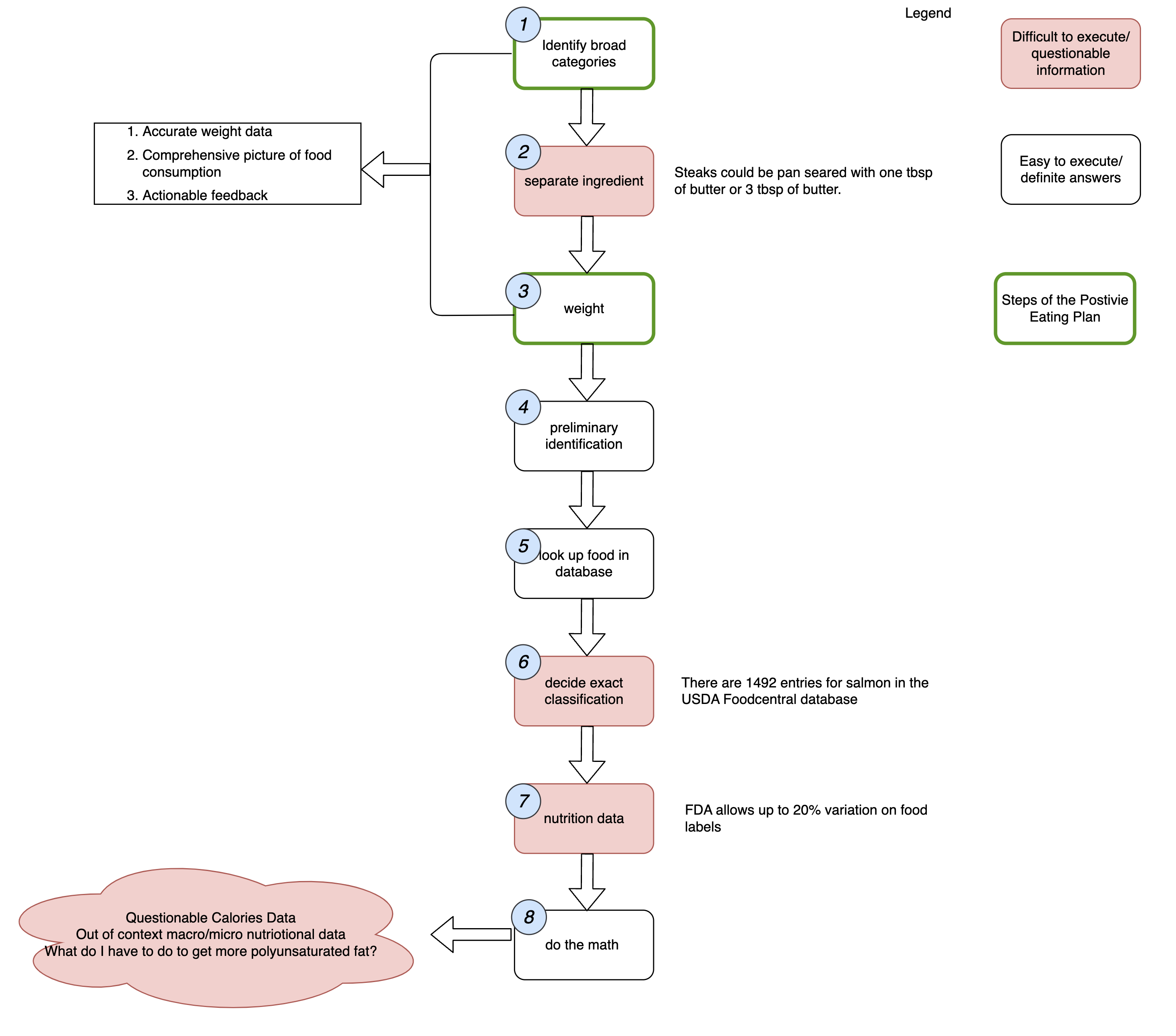
By step 3, you have collected a lot of useful and reliable data, like the type and weight of food. Then they are all discarded in favor of calculating a single, often misleading, calorie count. Why is the calorie figure so unreliable? To begin with, it is challenging to isolate the effects of individual ingredients unless consumed separately. Take, for example, an egg, which contains approximately 90 calories. However, if fried in two cubes of butter, the absorbed fat can add up to 100 extra calories. This illustrates why the FDA allows a 20% margin of error in the calorie counts listed on restaurant menus, even though professional kitchens likely weigh ingredients meticulously to manage costs and optimize efficiency.
Then in step 6, you face the challenge of determining precisely what food you are consuming. If you’ve ever attempted to look up calorie information in the USDA’s FoodData Central, you’ll know that it is far from a straightforward task. For example, there are 1,492 entries for “salmon” and 2,929 for “steaks.” Even if you limit your search to what the USDA terms “foundation foods”—data derived from minimally processed samples—significant variations remain. For instance, the calorie count for farm-raised salmon is 51% higher than that of wild salmon.
This presents a dilemma for developers of food-tracking apps: should they simplify the process for users by offering an average calorie figure, which could be grossly inaccurate, or should they require users to answer numerous questions to achieve a slightly more accurate, yet still unreliable, estimate? At this juncture, there is not a good answer, only less bad ones.
Even after all these efforts and arriving at a calorie number, it remains insufficient for the purpose of calculating your energy surplus. The whole intricate story is explained in The Science of Counting Calories. Here I will just highlight one crucial point: both fats (lipids) and proteins are essential building blocks of our bodies. The extent to which fats and proteins are diverted from being burned for energy varies from person to person. Why does it matter? Because your body will not make fat if it does not have surplus calories to put away.
Some might argue that food of identical weight may contain vastly different energy content. This is true, but only consequential if you have an unbalanced diet, a situation that signals bigger problems. This argument actually highlights a fundamental flaw in the reductionist view of food: consuming fewer calories has nothing to do with eating healthy. As Michael Pollan elegantly argues in In Defense of Food, food is not merely a collection of macro- and micronutrients; it is far more complex.
Going back to the question in the beginning, it’s not that The Positive Eating Plan simply tracks weight instead of calories. It recognizes the complexity and holistic nature of our diets. By replacing an error-prone, stress-induced process with a fuller picture of our dietary patterns, it enhances your understanding of how food truly impacts your health and well-being. How about your weight loss goal? To quote Giles Yeo, geneticist and the author of Why Calories Don’t Count: “If you focus on health, your weight will take care of itself.”
Comments
No comments yet. Be the first to share your thoughts!