
The Science of the Most Important Ingredient: Water
Why is Aunt Minnie in the hospital?
Because she fell on ice. But why did she fall? Because the ice was slippery. And why is ice slippery?
We take water for granted, but it has some unusual properties. These properties have a significant impact on cooking: from the texture of food to the efficiency of heat transfer during cooking. Understanding these properties is essential for mastering the art and science of cooking.
Ice is slippery because water behaves in peculiar ways: it melts under pressure. When a person’s weight bears down on ice, it causes a thin layer to melt, creating a slick surface. Water is among the rare substances that expand when frozen and contract when melted. But why does water behave in this unusual manner? The answer is the hydrogen bond.
The Hydrogen Bond
Water’s chemical formula is H₂O. In the water molecule, the oxygen atom forms one bond with each of the two hydrogen atoms. Chemists call these bonds covalent bonds, which consist of a pair of shared electrons. The oxygen nucleus is bigger and pulls on those electrons harder than the hydrogen nucleus, so those electrons shift closer to the oxygen nucleus. This makes the oxygen side of the bond slightly negative and the hydrogen side of the bond slightly positive, like a little magnet. When two water molecules come together, the negative side of one molecule’s H-O bond is attracted to the positive side of another molecule’s H-O bond. This intermolecular attractive force is the hydrogen bond. It is responsible for the unique chemical and physical properties of water.
In liquid water, the angle between the two H-O bonds is 104.5 degrees. As temperature drops, the water molecules become less restless and form more hydrogen bonds with each other. When water freezes, the molecules settle into a crystalline structure and snap into a grid, where the angle between the two H-O bonds widens to 109 degrees. Each water molecule occupies more space in ice than in liquid water. That’s why water expands when it freezes.
A polar covalent bond doesn’t form every time a hydrogen atom shows up. For instance, the C-H bond prevalent in organic compounds is not considered polar; therefore, fat molecules don’t form hydrogen bonds with each other or with water. That’s why oil does not dissolve in water.
But water is actually a very powerful solvent. For a solute (the substance to be dissolved) to dissolve in a solvent, the solvent molecules have to attach to the solute molecules, wrap them up, and pull them away from other molecules of the solute. In the case of salt, because the bond between the sodium and chloride atoms is an ionic bond (they don’t share a pair of electrons; the sodium atom has completely given up an electron to the chloride atom), the little magnets in water molecules tear the sodium ion away from the chloride ion. They exist as separate ions in the solution. In the case of sugar, the sucrose molecules don’t break apart, but they do form intermolecular bonds with the water molecules. Individual sucrose molecules are pulled away from each other by the water molecules that swarm them and dissolve into water.
It takes energy to break the existing bonds among sucrose molecules and the hydrogen bonds among water molecules. As temperature rises, more energy means more sugar dissolves in water. Sugar solutions of different concentrations, when cooled, result in different candy textures. The candy thermometer is a convenient tool to indirectly measure the sugar concentration by measuring the temperature of the syrup.
Boiling Water
Technically, what the candy thermometer measures is the syrup’s boiling point, which is another unusual characteristic of water. Normally, the boiling points of lightweight molecules are low. Due to low intermolecular forces, it doesn’t take much kinetic energy for a molecule to escape into the air. For instance, the boiling point of H₂S (a heavier molecule than H₂O) is -60°C. Water’s boiling point is unusually high because of the hydrogen bond. It takes 4.18 Joules of energy to raise the temperature of one gram of water by one degree. This number is called the specific heat capacity of a substance. In comparison, the specific heat of copper is 0.385 J/g·K, air: 1 J/g·K, meat: 1.7 J/g·K, olive oil: 2 J/g·K. Therein lies the answer to one of life’s mysteries: why does water take so long to boil? The highest power consumption of a countertop appliance in the United States is 1500 W. To boil 1 kilogram of water beginning at 20°C ambient temperature, and assuming a generous 80% heating efficiency, it will take 4.18 x 1000 x (100–20) / (1500 x 0.8) = 278 seconds or almost 5 minutes with a countertop water kettle.
When there are foreign substances in water, they elevate the water’s boiling point. The extra molecules get in the way of the escaping water molecules, so the water molecules need to have higher energy to break free. The macro manifestation of higher water molecule energy is higher temperature. However, during normal cooking, the salt concentration is not high enough to meaningfully change the boiling point of the liquid.
So how does water boil? On the stovetop, a pot of water is heated from the bottom. As the water at the bottom heats up, it rises and is replaced by the colder water that sinks to the bottom. These movements are called convection currents. The French have a word frémir, meaning to quiver or to tremble, that refers to this pre-bubble stage when the surface of the liquid is visibly moving.
The first bubbles show up around the bottom and the sides of the pot. These are not steam. They are air dissolved in water. Unlike sugar, air’s solubility decreases as temperature increases (that’s why you should keep your opened champagne in the fridge). As the temperature rises further, some hot water near the bottom turns into steam and starts to float up. But most of them can’t reach the surface because the cold water they encounter along the way condenses them back to liquid water. When you see a lot of bubbles rise to the top and pop, the water is boiling at 100°C. Measuring boiling water is a great way to calibrate your thermometer.
Freezing Water
Another common way to calibrate thermometers at home is to use an ice bath. The temperature of the ice bath should be 0°C under atmospheric pressure. This leads to an observation: water can remain liquid at 0°C.
When water forms ice, it starts at nucleation sites where a few water molecules cluster together to form a small crystal. Over time, more and more water molecules join, and the ice crystals grow in size. If the temperature is below 0°C but there are no nucleation sites, ice crystals will not form, and water remains liquid. The nucleation sites can be impurities or physical disturbances. For undisturbed pure water, ice does not form until -39°C, when a phenomenon called homogeneous nucleation happens. Modernist chefs have taken advantage of this property of water and created interesting dishes. Here is an example: https://www.youtube.com/watch?v=N1cZfOyqC78. Controlling the growth of ice crystals during the freezing process has a profound impact on the texture of frozen, and previously frozen, food.
Impurities get in the way of water molecules joining the ice crystals, which makes it harder for water to freeze. The result is freezing point depression. Ice cream is not one big hard block of ice because there is so much sugar dissolved in it that the ice crystals cannot grow very big. On the other hand, when the water molecules do join together and form crystals, they squeeze out the impurities. Freezing can purify water or extract dissolved substances, depending on your goal.
Most of our food is water. About 70% of beef and chicken is water. 93% of spinach is water. When we freeze food, we are freezing water. Water in food exists in two different places: inside cells and outside cells. The water outside cells is relatively pure and freezes at around -1°C. The water inside cells has more solutes like proteins, sugars, and salt, so it doesn’t freeze until under -20°C. Before the temperature drops below -20°C, more and more water molecules migrate out of cell walls and join the ice crystals outside cells. This makes the remaining liquid even more concentrated, and its freezing point further depressed. The growing crystals and the dehydrated cells lead to damaged texture and ruptures at the cell level.
The worst way to freeze food is to freeze it slowly. To freeze food, you need to transfer heat from inside the food to outside the food. This heat transfer path consists of two parts: inside the food, the heat is conducted. Outside the food, the heat is transferred by convection. The conductive heat transfer coefficient is a physical characteristic of the food; that is to say, you can’t change it without changing the food. So the only way to speed up the freezing is to accelerate the convective heat flow out of the surface of the food. According to Newton’s law of cooling, there are two ways to do this: increase the convection heat transfer coefficient or increase the temperature difference. You could change the former by increasing the airflow rate. Restaurants use something called the blast chiller. It’s like an anti-air fryer. Instead of hot air, it forcefully circulates very cold air around the food.
A large difference in temperature between the food and its environment can be accomplished by cryogenic freezing, which involves immersion or spraying the food with liquid nitrogen. Liquid nitrogen’s boiling point is about -196°C under atmospheric pressure. For home cooks without special equipment, a practical method is to cut the food into small pieces to both shorten the conduction path and increase the surface area for convection.
The key to great mouthfeel of ice cream is keeping the ice crystals small. There is a lot of dissolved sugar in ice cream, which interferes with the growth of ice crystals. Also, the churning of ice cream makers helps keep the crystals small by both physical disturbance and incorporating air. (Did you know the FDA requires that ice cream cannot have more than 50% air?) Commercial ice cream makers add ingredients that bond with free water in the mixture so the water molecules are not free to join ice crystals. Some animals have antifreeze proteins in their bodies. These proteins bind to small ice crystals to inhibit their growth. That’s why hibernating bears don’t freeze solid.
But there is a more interesting way to freeze water quickly: manipulating the pressure.
The Phase Change of Water
Intuitively, it’s quite obvious why applying pressure to a substance changes its freezing point: the enthalpy of the system increases, the entropy of the system decreases, which changes the Gibbs free energy…OK, maybe it’s not so obvious. Fortunately, you don’t have to take a class in thermodynamics to understand the phase diagram of water, which contains all the useful information for cooking.
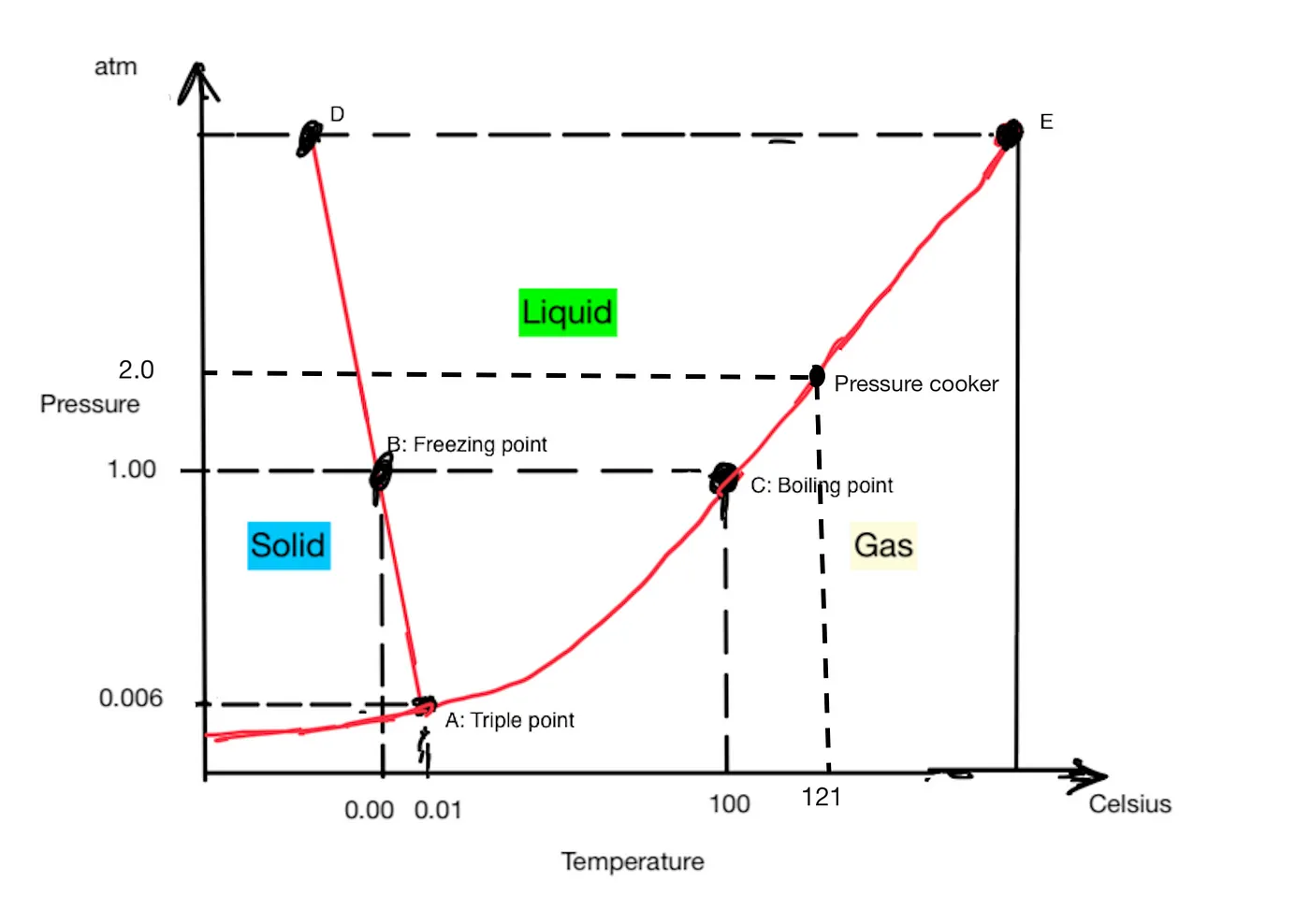
Figure 1: The Phase Diagram of Water
This diagram shows what state water is in at any temperature/pressure combination. The unit of the pressure is atm: the standard atmospheric pressure. Below the AE line, water is gas. Between AE and AD, water is liquid. Left of the AD line, water is solid. Water is special in that the AD line has a negative slope. At 1 atm and 0°C, if pressure is increased, water contracts and turns from solid into a liquid. In the phase diagram of most other substances, the boundary between solid and liquid has a positive slope, as in the phase diagram of nitrogen (Figure 2).
A few points of interest on the phase diagram of water are: C is the boiling point: 100°C at 1 atmospheric pressure. A is called the triple point, where the three phases (gas, liquid, solid) of water exist in equilibrium.
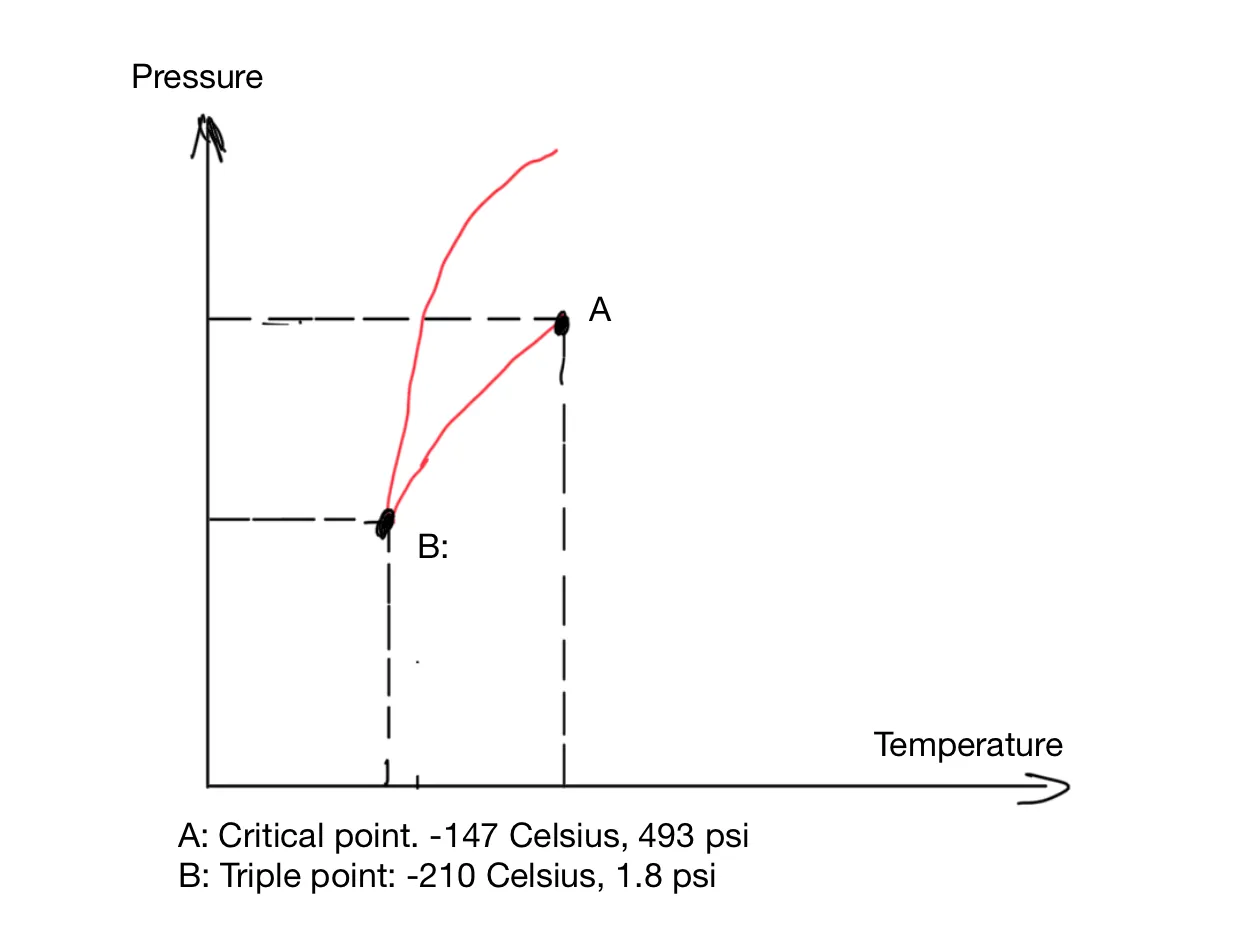
Figure 2: The Phase Diagram of Nitrogen
With the knowledge of the phase diagram, we can play different tricks with water. The tool home cooks are most familiar with is the pressure cooker (aka instant pot). In a typical pressure cooker, the pressure is raised to 2 atm/30 psi, under which the water boiling temperature becomes 121°C. At this temperature, you can soften potatoes for mashed potatoes in about 1/3 of the time.
Normally, when we dry food, water evaporates from the surface of the food. Water inside the food moves to the surface in liquid form, damaging cells and membranes along the way. If we could find a path in the phase diagram where ice turns into gas, without becoming liquid first, we can avoid the damage. Not only is the texture preserved, but also flavor loss is minimized because evaporating water vapor takes few flavor molecules along with it. The process of freeze-drying is so gentle that it’s widely used to preserve flowers.
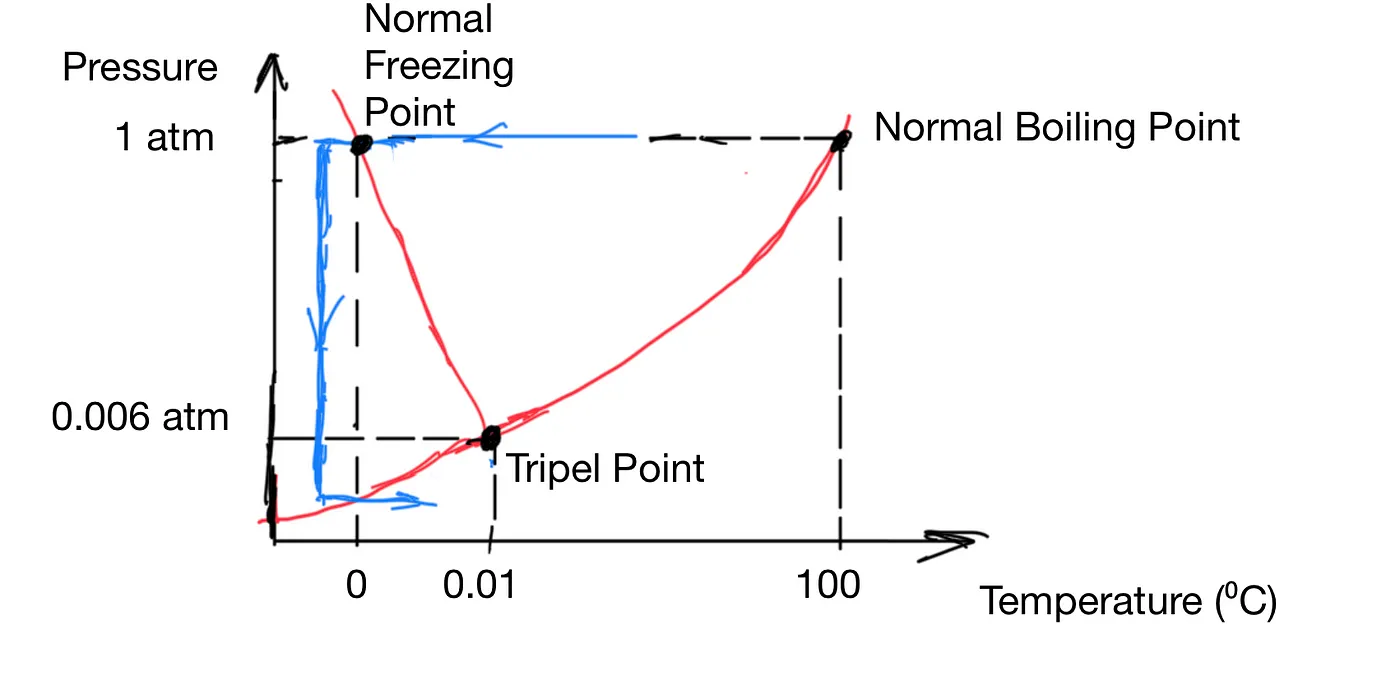
Figure 3: Freeze Drying
The blue path in Figure 3 illustrates how it can be done. Freeze-drying is a tricky process. The food has to be first frozen quickly to avoid damage during the freezing process. Then the pressure is dropped to about 6 mPa, and the food is heated slowly to let the ice sublimate. The heating has to be slow because if vapor pressure builds up in the freeze dryer, all of a sudden, you are at a different point in the phase diagram, and water becomes liquid.
By the way, sublimation doesn’t just happen at low pressure. It also happens at normal pressure. Freezer burn is due to sublimation. Evaporation happens when a water molecule gains enough energy to break free. It doesn’t know it’s in an ice lattice, or it’s in the freezer, or what pressure it’s under. As long as the temperature is not absolute zero, there is always a non-zero chance some molecules will gain enough energy.
Expensive sushi-grade fish needs to be frozen, and frozen well, on fishing boats, not only for preservation but also for killing parasites. The Japanese sushi industry seems to incubate a lot of interesting innovations in freezing technology. One flash freezer uses an electromagnetic field to control the growth of ice crystals, another creates special airflow so that the cold front hits all surfaces of the food simultaneously.
The phase diagram reveals two methods for transitioning water from the liquid to the solid phase: by either lowering the temperature horizontally or reducing the pressure vertically. The rate of temperature change is contingent on the heat transfer process, which typically occurs gradually. In contrast, pressure changes can occur at the speed of sound. Theoretically, if we raise the pressure, water can remain liquid below 0°C. If the pressure is then suddenly reduced, the liquid water rapidly solidifies, forming uniformly small ice crystals. This process is represented by the blue path in Figure 4. Experimentally, this method has demonstrated superior preservation of the texture of potatoes and tofu compared to blast chilling. Although commercial equipment for pressure-shift freezing is not yet available, ongoing research suggests potential future developments.
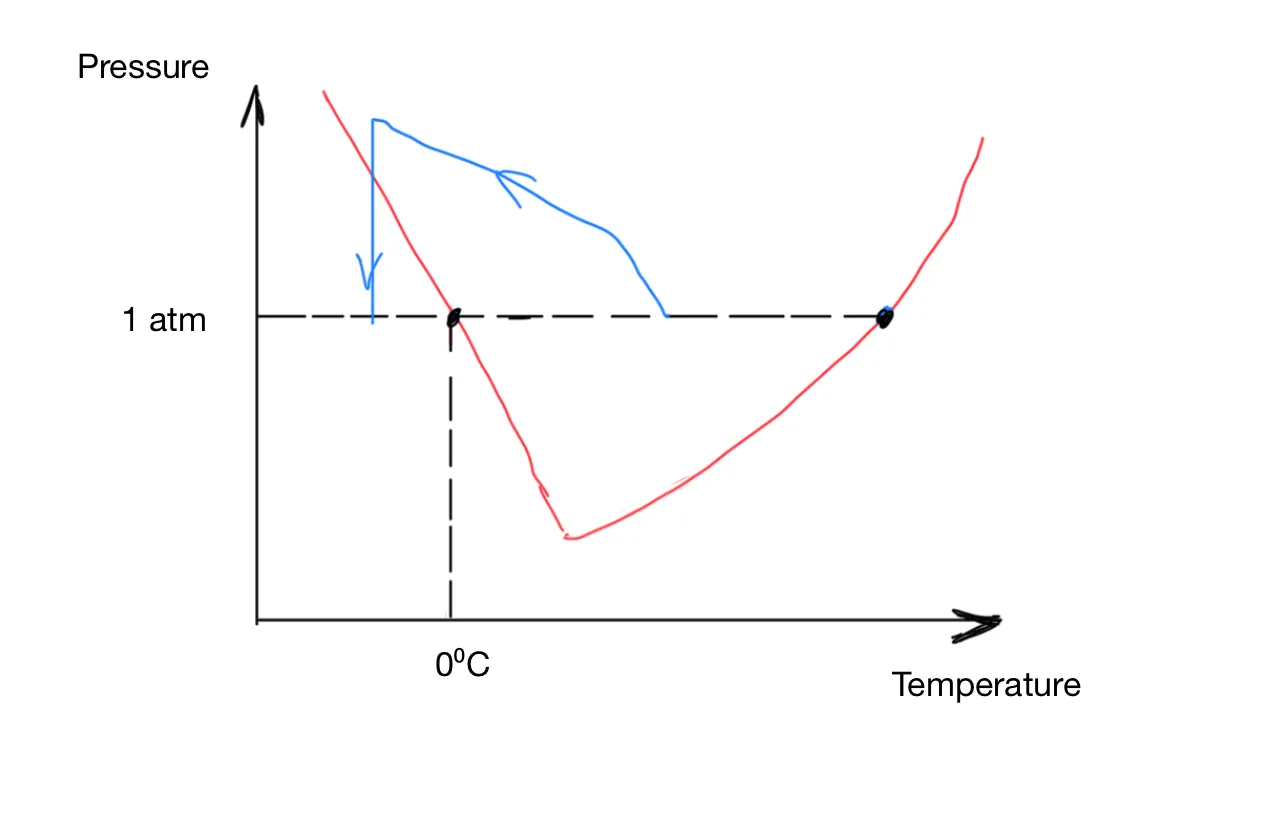
Figure 4: Pressure Shift Freezing
Understanding the science behind common phenomena can lead to magical solutions like pressure shift freezing. There are tremendous opportunities in applying well-known scientific principles to solve real problems for cooks.
Ideas for a Better Fridge
No, we are not talking about the abominations that pass for “smart” fridges, where the door is turned into an oversized iPad. If a screen is to be included on a refrigerator, it should display not the external temperature and humidity, but the conditions inside the fridge itself—and at multiple points within, rather than just a single measurement.
As previously discussed, it’s important to freeze food quickly. While the typical home freezer is adequate for storing frozen goods, it is highly inefficient for the initial freezing process. There should be a dedicated blast chiller chamber. When it’s not used as a blast chiller, it can be a regular cold chamber.
The point of the blast chiller is not low temperature, but rapid temperature drop. Blast chilling is not just for making ice cream and freezing fish for sushi. It’s also essential for food safety. As mentioned, the temperature range between 5°C and 55°C is a danger zone for bacterial growth. Allowing hot food to remain in this range for too long can be hazardous. Placing hot food directly into a refrigerator exacerbates the problem, as it can raise the temperature inside the fridge, potentially endangering other items.
In professional kitchens, stringent guidelines dictate that food left in the danger zone for more than four hours must be discarded. Department of Health guidelines state that to safely blast chill food, its temperature must be reduced from +70°C to +3°C or below within 90 minutes. The CDC reports that improper cooling (including improper cooling in the fridge) is, by far, the number one cause of bacterial growth leading to foodborne illnesses. There is also a culinary benefit: a quick chill thickens and gels meat juices before they have a chance to leak.
However, the challenge is not limited to rapid cooling. Improper thawing can similarly expose food to the danger zone for extended periods. The fundamental issue with thawing is that ice conducts heat more efficiently than water. During freezing, the outer layer of food turns to ice first, enhancing heat conduction. Conversely, during thawing, the outer layer liquefies first, slowing down heat transfer. A blast chiller, with its precise control of heating and cooling cycles and accelerated airflow, can also be employed in reverse to expedite the thawing process safely.
It may even be possible for the chiller to incorporate pressure shift freezing technology. As a large appliance equipped with a power compressor, the fridge is already well-suited to manipulating pressures. With the addition of an edge sealer, the appliance could double as a vacuum sealer. Add a scale, a camera, an RFID tag in the reusable bag, and an image recognition algorithm, and even the most indifferent cook could have detailed, traceable information for every item stored in the freezer, without the need to manually label anything.
Speaking of lazy cooks, when are we going to get a foot-operated fridge door?
A Dramatic Story about Water and Heat
This is not a story about firefighters. It’s a story about oranges.
Citrus trees cannot stand cold. They start dying if the temperature drops below the freezing point of water.
Water, owing to the hydrogen bond, has a high heat capacity. It requires considerable energy to alter its temperature. Consequently, bodies of water help moderate the climate of surrounding land, maintaining temperatures within a relatively stable range. During the big freeze of 1895, almost all of Florida’s citrus industry was decimated, with the notable exception of the orange groves around Keystone City, where there are a number of lakes. The city later changed its name to Frostproof.
In the book Oranges, the master storyteller John McPhee described this battle between citrus farmers and Arctic air. On a cold night, spraying water on trees to keep them warm may seem counterintuitive. However, that’s the daring strategy employed by some ingenious growers during the 1962 freeze. Water releases heat when it freezes. As long as the sprayers stay on and the mixture of water and ice persists, the temperature around the trees stays at exactly 0°C, or 32°F. However, as more water is applied, the accumulating ice grows increasingly heavy. If the sun doesn’t come up and thaw the ice before it becomes too heavy, the branches will break under the weight. Not all the growers won this race in 1962. Those who did woke up the next day and saw the price of their oranges triple.
Comments
No comments yet. Be the first to share your thoughts!